

Pelvèra
You always know where the toilets are. You're not the only one.
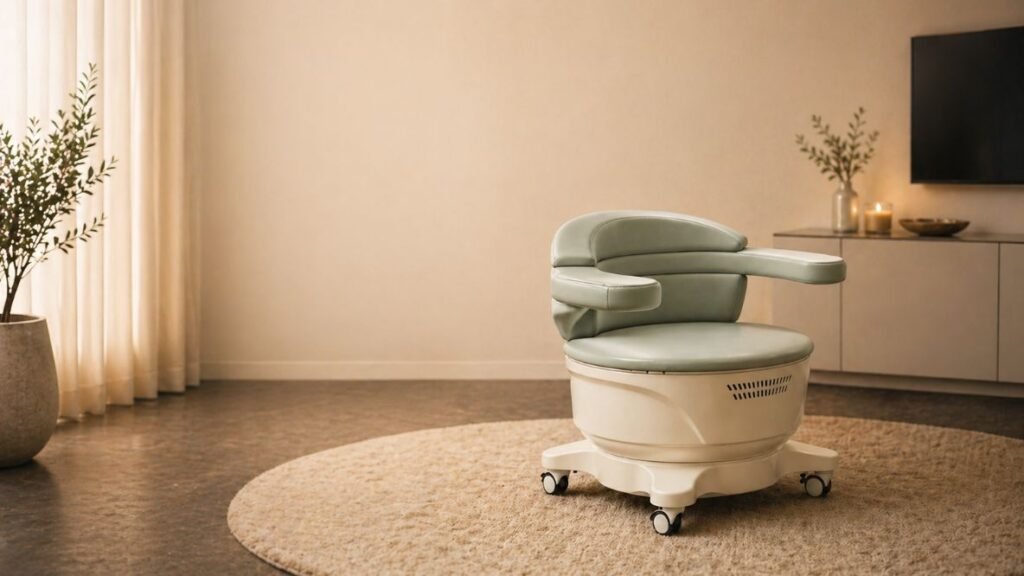
Pelvèra is a 28 minute seated session that supports pelvic floor activation. Fully clothed. Used by women and men in Littlehampton.
Pelvèra
You always know where the toilets are. You're not the only one.
Pelvèra is a 28 minute seated session that supports pelvic floor activation. Fully clothed. Used by women and men in Littlehampton.
You recognise the small daily moments.
Most people don't use the words pelvic floor. They just know the moments they've started planning around.
If you nodded at even one — you're in the right place.
Most British women never tell anyone. Even their GP.
From a survey of two thousand women by the Royal College of Obstetricians and Gynaecologists.
Fully clothed. No awkward conversation.
You don't need to undress. You don't need to explain every private detail. You sit on the chair, we set the intensity with you, and you stay in control the whole time.
- Ask any question before anything starts.
- Lower the intensity at any moment.
- Stop the session whenever you want to.
What a session actually feels like.
Most people have never tried anything like this. Here's the honest version, minute by minute, so you know exactly what you're walking into.
- 0 min
You arrive
Park outside the studio, ring the buzzer, step into the room. A brief hello, water if you'd like it, a moment to settle.
- 2 min
You sit down
Fully clothed. Feet flat on the floor. The seat finds your pelvic floor for you — you don't need to position anything.
- 4 min
The chair switches on
A gentle, rhythmic pulse begins. Most people describe it as a deep internal tap — not painful, unfamiliar for the first minute, then it becomes background. What you might feel:
Pulsing Tapping Muscle contractions A lifting sensation - 8 min
You read your book
Or check your phone, or close your eyes. The chair does its work. There's nothing for you to do — the intensity shifts gently through the session.
- 28 min
The session ends
The chair winds down. You stand up, collect your bag, and walk back to your car. No recovery time, no soreness, no follow-up needed.
Four ways this quietly shows up.
Different stories. Same private room. Same chair. Same 28 minutes.
"It started after Olivia. I told myself it would settle. Eight years later I still cross my legs before I sneeze, and I haven't been on a trampoline since 2017."
"I'm fitter than half the women in my office. Then last spring my body started leaking during HIIT, and I'm furious about it. I am not just going to accept this."
"I never told my GP. I always check where the loos are. I thought this is just what happens. My daughter sent me your link and I sat with it for a week before I read it properly."
"The surgery went well. The recovery has had one part nobody warned me about. Six months on, I still need to know where the gents are."
You know which one feels close to your story. We don't need you to explain every detail before you sit down.
It's not your fault. The method failed you.
You were told to do them. You tried. Then life happened.
You forgot. When you remembered, you weren't sure you were doing them right. Were you using the right muscle? Holding your breath? Were the glutes doing all the work?
You're not alone in this. Research suggests around 30% of women may be unable to voluntarily contract the pelvic floor correctly — and that can be higher in people already dealing with pelvic floor dysfunction. No wonder guessing your way through exercises feels so frustrating.
And even done perfectly, manual exercises only work with consistent daily practice over three to six months. Most people give up by week three.
The kegel method works in theory. In practice, it asks for something most lives don't have room for.
More than a bladder problem. Far more.
The pelvic floor sits at the base of your body, doing six different jobs at once. Most people only notice it when one of them starts to slip.
This is bigger than leaking when you laugh.
It touches your daily comfort, your posture, your confidence, your intimacy, and how connected you feel to your own body. Most of it goes unnoticed — until it doesn't. So here's what the chair actually does about it.
A chair that does the work for you.
Pelvèra uses HIFEM technology — High-Intensity Focused Electromagnetic energy — to stimulate the pelvic floor muscle group while you sit fully clothed.
The field passes through the seat and creates deep contractions in muscles most people struggle to train properly on their own. You sit. The chair does the work.
In practical terms, that gives many people a level of pelvic floor work they'd be unlikely to match with stop-start home exercises — especially when those exercises are inconsistent or not done correctly.
Ratio 4:5 portrait or 3:4.
Mood Considered, technical, calm. Premium product photography.
What the research says.
The message is simple. Published HIFEM studies have reported measurable improvement in leakage scores and pad use — though individual results still vary.
average improvement in urinary incontinence questionnaire score, reported at the three-month follow-up.
average reduction in absorbent pad use, reported at the three-month follow-up.
women with stress, urge or mixed urinary incontinence symptoms were included in that published study.
A commonly used course in the published study was six sessions over three weeks. That doesn't guarantee the same result for everyone — it simply shows the technology has been studied using measurable outcomes.
The pattern many clients describe.
Based on the usual client journey we explain in clinic. It is not a quote from one single study, and individual results vary.
The first visit is mostly about knowing what it feels like and whether it feels right for you.
Some people start noticing small moments of better control, or less bracing.
People often describe more awareness, more control, and a greater sense of security.
The response can keep building over the following weeks. Maintenance sessions may help some people hold the gain.
The questions people actually ask.
Most things are covered in your short suitability form before you arrive, so you don't need to explain everything at the desk.