

Ear equalising tips for HBOT beginners in Littlehampton
Most people don't think about their ears before their first HBOT session. Then the pressure starts rising and they notice something familiar. Like descending in a plane, or going underwater. For some it clears on its own. For others it needs a little help.
That's what this guide is for. Everything you need to know before you get in the chamber.
At a glance
- When you might notice it: during pressurisation, and sometimes on the way back down
- What it should feel like: gentle pressure, not sharp pain
- The rule: small, gentle movements - never force it
- Best timing: start early, before pressure builds
- If you feel blocked: tell us - we slow down or stop
- If you're bunged up with a cold: reschedule - it's not worth it
Why your ears feel pressure during HBOT
Your ears contain a small channel called the Eustachian tube. It connects the middle ear - the air-filled space behind your eardrum (tympanic membrane) - to the back of your throat. Its job is to equalise the air pressure on both sides of the eardrum as conditions change around you.
Most of the time this happens automatically. You swallow, the tube opens briefly, pressure balances. You don't notice it.
During HBOT at ReviveO2, the chamber pressurises to 1.5 ATA - one and a half times normal atmospheric pressure. As pressure rises during pressurisation, and then falls again during depressurisation, the Eustachian tube sometimes needs active help to keep up. If it doesn't equalise, pressure builds against the eardrum. That's the fullness you feel.
This is the same mechanism that affects divers, people in aircraft, and anyone driving over a steep hill. The difference with HBOT is that we control the speed. If your ears need more time at any point, we slow down.
The comfort and safety rule
If you feel sharp pain, tell us straight away.
Gentle pressure or a feeling of fullness is normal during equalisation. Sharp pain is not. We can slow the pressurisation, pause at a holding pressure, or stop and depressurise at any point. There's no version of this where you push through.
Simple ear equalising methods for beginners
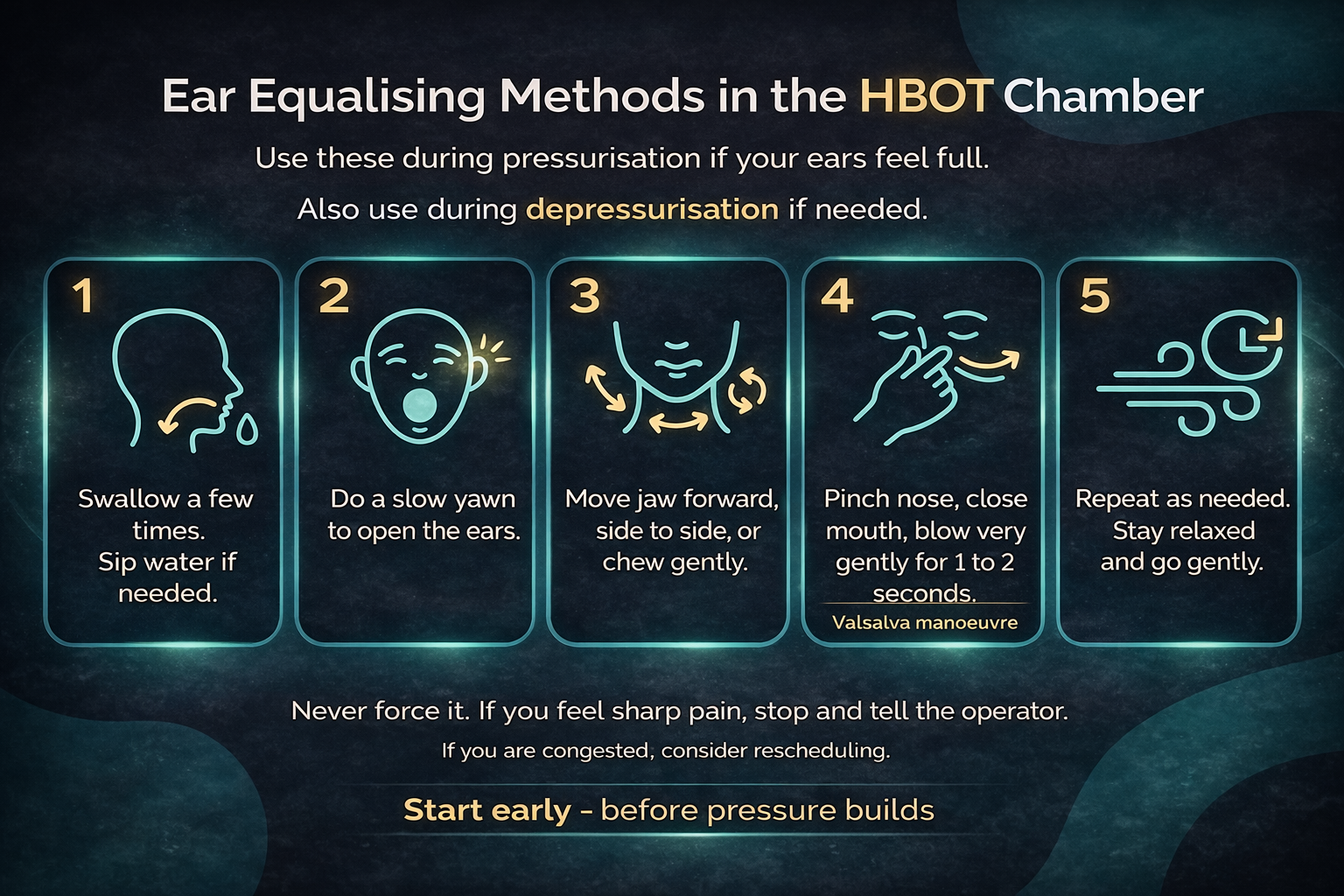
Try these in order, gently. Start early - before you feel significant pressure - and repeat little and often throughout pressurisation.
Swallow
Swallowing activates the small muscles that open the Eustachian tube. A few sips of water make this easier. Most people find this is enough on its own for the first half of pressurisation.
Yawn
A slow yawn opens the tube more widely than swallowing. A deliberate fake yawn works just as well as a real one.
Jaw movement
Move your jaw side to side, or forward and back, as if chewing slowly. This works the same muscles as yawning and is easier to repeat in quick succession.
Valsalva manoeuvre named technique
Pinch your nose, close your mouth, and blow very gently for about one second. This pushes air into the Eustachian tube from the throat side and can pop it open. If one attempt doesn't work, switch back to swallowing - a hard blow doesn't help.
Toynbee manoeuvre if Valsalva doesn't work
Pinch your nose and swallow at the same time. This creates negative pressure that helps the tube open from the other direction. Useful when the Valsalva isn't doing the job.
Slow breathing and staying relaxed
Tension in the jaw and throat makes equalisation harder. Slow breathing keeps both relaxed. If you're anxious about equalising, you're more likely to tense up - which makes it worse.
What not to do
- Do not force a hard blow with your nose pinched
- Do not wait until the pressure feels strong before trying - start early
- Do not try to push through sharp pain
- Do not arrive heavily blocked and hope it will clear once you're in
- Do not hold your breath while trying to equalise - keep breathing slowly
How long does equalising take?
At ReviveO2, pressurisation to 1.5 ATA takes around 10 to 15 minutes. Most of the equalising happens in the first half of that. Once you're at full pressure, the middle ear pressure stabilises and you won't need to equalise again until we start coming back down.
Depressurisation is usually easier than pressurisation. The Eustachian tube tends to open more freely when pressure is releasing rather than building. Some clients barely notice it on the way down.
If you have a cold, blocked sinuses, or ear pain
When your Eustachian tube is inflamed or congested - from a cold, hayfever, or a sinus infection - equalising is harder. The tube is narrower. It takes more effort to open, and the risk of discomfort is higher.
In that case, rescheduling is the right call. One missed session is a much better outcome than a session that stops early or leaves your ears uncomfortable for a day.
If you have an ongoing ear condition, a history of ear surgery, or a perforated eardrum, check with a clinician before booking. We can work with GP guidance - we just need to know before you come in.
Is HBOT equalising different from scuba diving?
The mechanism is the same - Eustachian tube, middle ear pressure, Valsalva - but the context is different. In scuba diving, descent is faster and pressure changes are more significant. In wellness HBOT at 1.5 ATA, the pressure change is modest and the pace is slow.
Experienced divers usually find HBOT sessions easier than diving because the pressure differential is smaller. First-time users with no diving background adapt quickly too - the techniques are simple and Matej guides you through them at the start of every session.
How we help at ReviveO2
We walk through ear equalising with every first-time client before the session starts. During pressurisation, Matej monitors pace and adjusts based on how you're doing. If you signal that you need more time, we pause at a holding pressure while you equalise, then continue.
We're at Bizspace, Courtwick Lane, Office 46, Littlehampton BN17 7TL, serving clients from Littlehampton, Worthing, Rustington, East Preston, Arundel, Bognor Regis, and Chichester.
FAQs
Related guides
Intro session is £35. Matej will guide you through everything before you get in.
Book your first HBOT sessionEar equalising tips for HBOT beginners in Littlehampton
Most people don't think about their ears before their first HBOT session. Then the pressure starts rising and they notice something familiar. Like descending in a plane, or going underwater. For some it clears on its own. For others it needs a little help.
That's what this guide is for. Everything you need to know before you get in the chamber.
At a glance
- When you might notice it: during pressurisation, and sometimes on the way back down
- What it should feel like: gentle pressure, not sharp pain
- The rule: small, gentle movements - never force it
- Best timing: start early, before pressure builds
- If you feel blocked: tell us - we slow down or stop
- If you're bunged up with a cold: reschedule - it's not worth it
Why your ears feel pressure during HBOT
Your ears contain a small channel called the Eustachian tube. It connects the middle ear - the air-filled space behind your eardrum (tympanic membrane) - to the back of your throat. Its job is to equalise the air pressure on both sides of the eardrum as conditions change around you.
Most of the time this happens automatically. You swallow, the tube opens briefly, pressure balances. You don't notice it.
During HBOT at ReviveO2, the chamber pressurises to 1.5 ATA - one and a half times normal atmospheric pressure. As pressure rises during pressurisation, and then falls again during depressurisation, the Eustachian tube sometimes needs active help to keep up. If it doesn't equalise, pressure builds against the eardrum. That's the fullness you feel.
This is the same mechanism that affects divers, people in aircraft, and anyone driving over a steep hill. The difference with HBOT is that we control the speed. If your ears need more time at any point, we slow down.
The comfort and safety rule
If you feel sharp pain, tell us straight away.
Gentle pressure or a feeling of fullness is normal during equalisation. Sharp pain is not. We can slow the pressurisation, pause at a holding pressure, or stop and depressurise at any point. There's no version of this where you push through.
Simple ear equalising methods for beginners
Try these in order, gently. Start early - before you feel significant pressure - and repeat little and often throughout pressurisation.
Swallow
Swallowing activates the small muscles that open the Eustachian tube. A few sips of water make this easier. Most people find this is enough on its own for the first half of pressurisation.
Yawn
A slow yawn opens the tube more widely than swallowing. A deliberate fake yawn works just as well as a real one.
Jaw movement
Move your jaw side to side, or forward and back, as if chewing slowly. This works the same muscles as yawning and is easier to repeat in quick succession.
Valsalva manoeuvre named technique
Pinch your nose, close your mouth, and blow very gently for about one second. This pushes air into the Eustachian tube from the throat side and can pop it open. If one attempt doesn't work, switch back to swallowing - a hard blow doesn't help.
Toynbee manoeuvre if Valsalva doesn't work
Pinch your nose and swallow at the same time. This creates negative pressure that helps the tube open from the other direction. Useful when the Valsalva isn't doing the job.
Slow breathing and staying relaxed
Tension in the jaw and throat makes equalisation harder. Slow breathing keeps both relaxed. If you're anxious about equalising, you're more likely to tense up - which makes it worse.
What not to do
- Do not force a hard blow with your nose pinched
- Do not wait until the pressure feels strong before trying - start early
- Do not try to push through sharp pain
- Do not arrive heavily blocked and hope it will clear once you're in
- Do not hold your breath while trying to equalise - keep breathing slowly
How long does equalising take?
At ReviveO2, pressurisation to 1.5 ATA takes around 10 to 15 minutes. Most of the equalising happens in the first half of that. Once you're at full pressure, the middle ear pressure stabilises and you won't need to equalise again until we start coming back down.
Depressurisation is usually easier than pressurisation. The Eustachian tube tends to open more freely when pressure is releasing rather than building. Some clients barely notice it on the way down.
If you have a cold, blocked sinuses, or ear pain
When your Eustachian tube is inflamed or congested - from a cold, hayfever, or a sinus infection - equalising is harder. The tube is narrower. It takes more effort to open, and the risk of discomfort is higher.
In that case, rescheduling is the right call. One missed session is a much better outcome than a session that stops early or leaves your ears uncomfortable for a day.
If you have an ongoing ear condition, a history of ear surgery, or a perforated eardrum, check with a clinician before booking. We can work with GP guidance - we just need to know before you come in.
Is HBOT equalising different from scuba diving?
The mechanism is the same - Eustachian tube, middle ear pressure, Valsalva - but the context is different. In scuba diving, descent is faster and pressure changes are more significant. In wellness HBOT at 1.5 ATA, the pressure change is modest and the pace is slow.
Experienced divers usually find HBOT sessions easier than diving because the pressure differential is smaller. First-time users with no diving background adapt quickly too - the techniques are simple and Matej guides you through them at the start of every session.
How we help at ReviveO2
We walk through ear equalising with every first-time client before the session starts. During pressurisation, Matej monitors pace and adjusts based on how you're doing. If you signal that you need more time, we pause at a holding pressure while you equalise, then continue.
We're at Bizspace, Courtwick Lane, Office 46, Littlehampton BN17 7TL, serving clients from Littlehampton, Worthing, Rustington, East Preston, Arundel, Bognor Regis, and Chichester.
FAQs
Related guides
Intro session is £35. Matej will guide you through everything before you get in.
Book your first HBOT session